Ardenica Monastery
Ardenica Monastery
Near Lushnjë, Ardenica Monastery combines Byzantine architecture, frescoes from the Korça school and the memory of Skanderbeg's wedding in 1451.
Nicknamed the « castle of Myzeque », the Ardenica Monastery ranks among the major Orthodox complexes in Albanie. Founded in the 13th century north of Lushnjë, it brings together frescoes, icons signed by the Korça school and a rich history, from the marriage of national hero Skanderbeg in 1451 to its role in the Albanian cultural renaissance.
Why visit Ardenica Monastery
- A fortified Byzantine complex spanning 2,500 m² with ramparts still standing, featuring a vaulted portico dated to 1474.
- The place where Skanderbeg married Donica Arianiti in April 1451, in the presence of the League of Lezha and European emissaries.
- A polychrome and gilded wooden iconostasis sculpted in 1744 by artisans from Moscopole.
- Icons by Konstantin Shpataraku, a leading figure of the Korça school nourished by Italian Renaissance.
- The first identified inscription in Albanian within an Orthodox church.
History of the monastery
The site predates Christian foundation: an ancient pagan temple dedicated to Artemis is believed to have stood here, giving rise to the name Ardenica. The Church of the Trinity, later integrated into the complex, is considered to have been erected as early as the 10th century. Following the siege of Berat in 1281, Byzantine emperor Andronikos II Palaiologos ordered the monastery's construction to commemorate the victory against the Angevins.
In April 1451, Skanderbeg married Donica Arianiti here. The wedding held diplomatic significance: the gathering brought together the League of Lezha, Albanian and Serbian lords, representatives of the Kingdom of Naples, the Republic of Venice, and the Republic of Ragusa. Five hundred armed cavalry accompanied the event.
In 1743, under the influence of religious figure Nektarios Terpos, wealthy merchants from Moscopole financed the main church dedicated to the Nativity of the Virgin Theotokos. A fresco preserves a prayer from the abbot: « Virgjin ë Mame eperndis uro prë nee faj torëte », considered the first inscription in Albanian within an Orthodox church.
Thanks to its agricultural lands and proximity to the Via Egnatia, the monastery became an intellectual center. Its library is estimated to have housed over 32,000 volumes and trained numerous clergy. In the 19th century, classes taught in the Albanian language took place here, linked to the national renaissance movement Rilindja Kombëtare. The monastery subsequently participated in founding the Autocephalous Orthodox Church of Albanie, recognized by the Patriarchate of Constantinople in 1937.
A fire devastated the library in 1932; an 18th-century Greek copy of the Old Testament was salvaged. In 1957, bishop Irene Banushi, a religious opponent of Enver Hoxha's regime, was placed under house arrest here. In 1967, his intervention prevented the site's destruction during an operation conducted by students. Closed to worship in 1969, the monastery served as a military base, was classified as an Albanian cultural monument, then transformed into a leisure center in 1988. The Church resumed its management in 1991 and monks returned in 1996.
What to see on site
The fortified complex
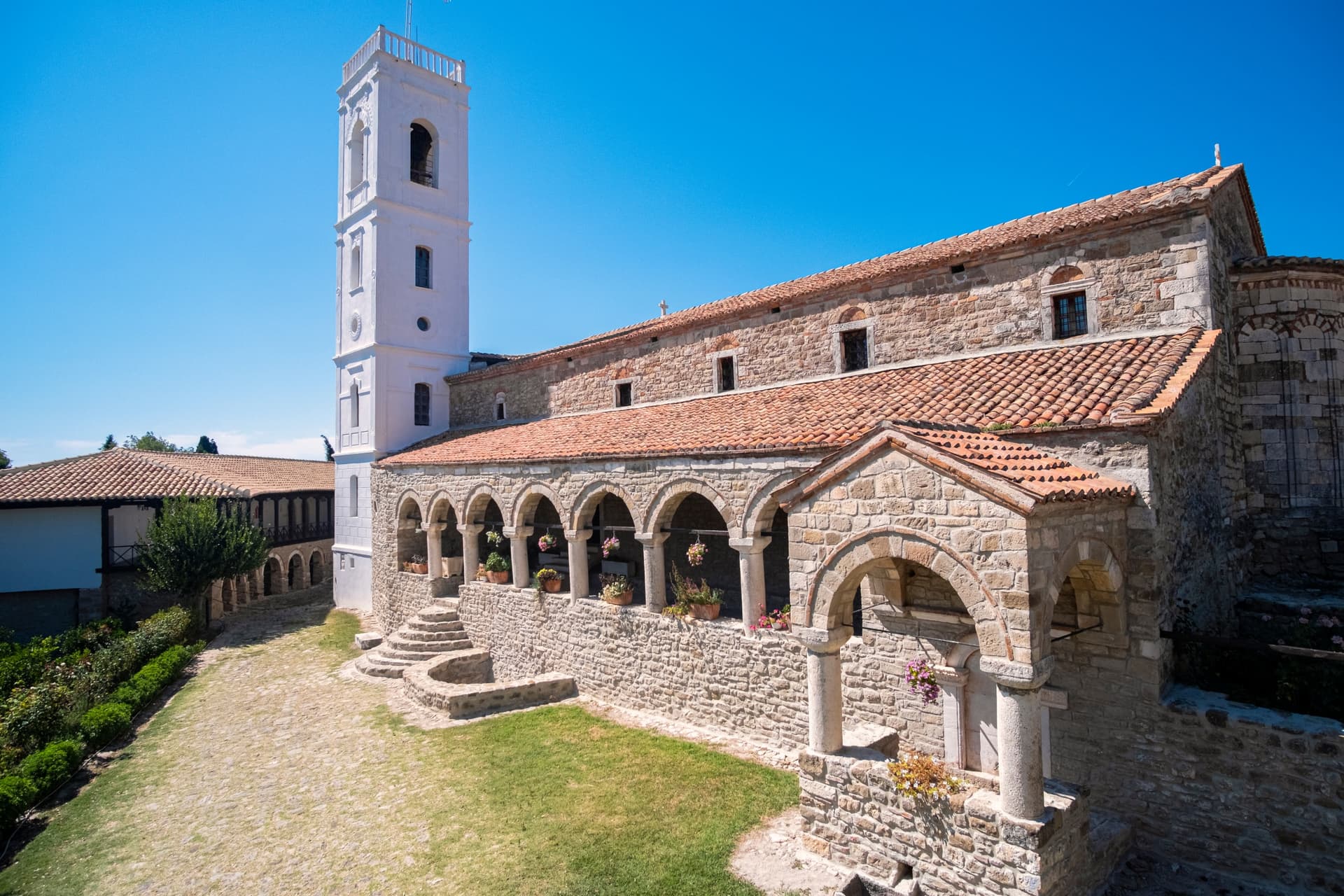
The monastery covers 2,500 m², enclosed by high ramparts and accessed via a vaulted portico from 1474. The architecture follows Byzantine tradition while incorporating Romanesque elements. The complex brings together the main church (catholicon), the Church of the Trinity, the konak (guesthouse), stables, a bakery, and an oil mill. Several materials have been reused from the nearby ancient site of Apollonia of Illyria.
The Church of the Nativity of the Virgin Theotokos
The church follows the Byzantine basilica model, covered with tiles. The south narthex features a 24-meter bell tower and preserves a fresco of the Last Judgment. Inside, wooden columns punctuate the nave. The polychrome and gilded wooden iconostasis, sculpted in 1744 by Moscopole artisans, ranks among the site's major treasures.
Icons and frescoes
Konstantin Shpataraku, a leading figure of the Korça school influenced by Italian Renaissance, signed most of the icons. To the left of the « royal doors », the Virgin Theotokos is depicted giving birth to the Child. The complex also features Christ on the Cross, treated with the sobriety characteristic of Byzantine tradition, and Christ Pantocrator on his throne. Two frescoes honor Serbian prince Saint Jovan Vladimir and Albanian lord Karl Thopia. An icon of Saint George, painted by Gjon Çetiri, was transferred to the National Museum of History in Tirana. The Zografi left a fresco of the Seven Apostles of Bulgaria, who evangelized the Slavs and Albanians from the 9th century onward. The walls also display the portrait of Saint John Koukouzeles, a Byzantine musicologist who contributed to enriching Orthodox sacred music.
Practical information
- Location: 18 km north of Lushnjë, 8 km from Fier, on the SH67.
- Visit duration: allow 1 to 1.5 hours on site.
- Dress code: shoulders and legs covered recommended, as the site remains an active place of worship.
- Hours: open daily during daylight hours, from morning to evening (verify locally).
- Admission: free at last update; brochures and donations support site maintenance.
How to get there
The monastery is served by the SH67, between Fier and Lushnjë. From Lushnjë, local buses and car rental services reach the site in about twenty minutes. From Tirana, allow approximately 1.5 hours' drive. A rental car remains the most flexible option for combining Ardenica with nearby archaeological sites.
When to visit
The visit suits all seasons. Spring and early autumn offer the most pleasant conditions, with mild temperatures and favorable light for exterior frescoes. Summer is warmer and busier; winter remains possible but with shorter daylight hours. Orthodox festivals, particularly the Nativity of the Virgin on September 8, occasion specific celebrations at the monastery.
What to see nearby
- Apollonia of Illyria: Greco-Roman ancient site about twenty minutes away, whose materials were reused at Ardenica.
- Fier: nearby town serving as a logical access point to the monastery.
- Berat Castle: inhabited citadel and Ottoman quarter, about 1 hour's drive away.
- Benja thermal springs: nature stop in the southern part of the country.
Frequently asked questions
Frequently asked questions
It sits on the SH67 road, 18 km north of Lushnjë and 8 km from Fier, on a hill overlooking the Myzeque plain.
It was in its church that Skanderbeg married Donica Arianiti in April 1451, in the presence of the League of Lezha and representatives from Naples, Venice, and Ragusa, accompanied by 500 armed cavalry.
Yes. Closed to worship in 1969 under the communist regime, it was returned to the Church in 1991 and monks resettled here in 1996.
The 1744 iconostasis sculpted by Moscopole artisans, icons by Konstantin Shpataraku, the Last Judgment fresco in the south narthex, and the portrait of Saint John Koukouzeles.
One to one and a half hours suffice to tour the church, the Church of the Trinity, and the ancillary buildings.
Include Ardenica in your trip
Ardenica Monastery naturally fits into an itinerary connecting Tirana, Berat, and the Ionian coast. To plan a coherent stay around the country's Byzantine, ancient, and natural sites, consult our suggestions for travel in Albanie.
Nearby
Interested in this visit?
We can include it in your personalised itinerary.