The Hadum Mosque
The Hadum Mosque
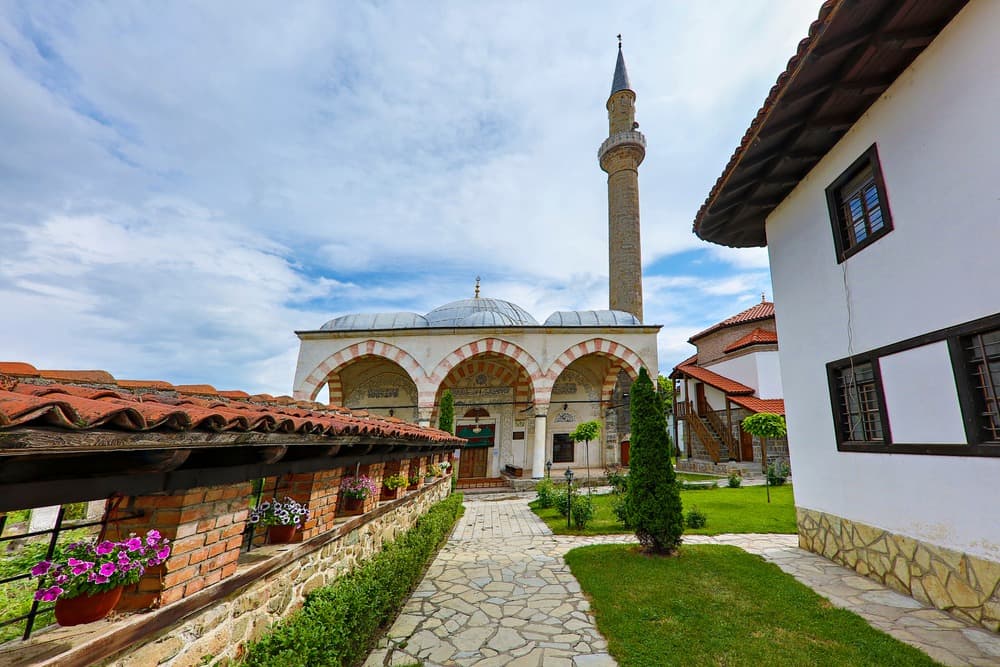
Built around 1594-1595 in the old bazaar of Gjakova, the Hadum Mosque stands as a major landmark of Ottoman architecture in the Western Balkans.
The Hadum Mosque rises at the heart of the old bazaar of Gjakova, a town in western Kosovo near the Albanian border. Built in the late 16th century under Ottoman rule, it ranks among the oldest Muslim places of worship in the region and remains an architectural and cultural landmark of western Kosovo.
Why visit the Hadum Mosque
The Hadum Mosque offers a masterclass in classical Ottoman architecture applied to a Balkan setting: an octagonal-base dome, stone minaret, Arab-Andalusian porch, and wall paintings featuring floral motifs and Quranic calligraphy. Beyond the building itself, the site tells a tumultuous story—from Ottoman splendor to the 1999 Kosovo war and the slow reconstruction that followed. Its location within the old bazaar makes it easy to pair a visit with a stroll through Gjakova's historic center.
History of the mosque
The Hadum Mosque was constructed around 1594-1595, when Kosovo was part of the Ottoman Empire. The construction is said to have lasted some twenty years—an unusually long timeframe whose exact reasons remain unclear. The building takes its name from Hadum Suleiman Aga Bizeban, chief of the eunuchs in the Ottoman harem, who is believed to have funded its foundation.
The plans are traditionally attributed to Mimar Sinan, chief architect of the Ottoman court. However, this attribution should be treated with caution: Sinan died in 1588, well before the mosque's presumed construction date. The project was likely designed within his workshop or by one of his successors trained in his school.
Over the centuries, the mosque evolved. In 1842, an Arab-Andalusian porch was added to the northwest facade, crowned with three small lead-covered domes. In 1955, the Serbian Republic recognized the building as a "cultural monument of exceptional importance." A first restoration was undertaken in 1968 to preserve its frescoes and structure.
During the 1999 Kosovo war, the mosque suffered severe damage at the hands of Serbian forces: the minaret, portico, and adjoining religious school were set ablaze, and much of the historic library's manuscripts were destroyed. Restoration work began in the early 2000s, was interrupted in 2002, resumed shortly after, and was completed in 2005. In 2016, a new library was built in the monument's garden, as a tribute to the one that had been lost.
What to see on site
The prayer hall
The main hall features a square floor plan crowned by a dome rising approximately 13.5 meters. The walls are adorned with painted floral and geometric motifs in shades of red, green, and blue, as well as Arabic calligraphy featuring Quranic verses. Eleven windows illuminate the space, three of them arranged in a triangular pattern. Small holes pierced in the upper portion of the walls ensure optimal acoustic distribution of sermons throughout the hall.
The mihrab and minbar
The mihrab, a semicircular niche recessed into the southeastern wall, indicates the direction of Mecca. To its right stands the minbar, a finely carved wooden pulpit from which the imam delivers the Friday sermon.
The portico
Added in 1842, this Arab-Andalusian porch occupies the northwest facade. Its three small lead-covered domes shelter worshippers praying outside when the main hall reaches capacity.
The minaret and gallery
The minaret is a polygonal stone tower equipped with two staircases—one internal, one external. It serves as a visible landmark from several quarters of Gjakova and carries the call to prayer. The wooden women's gallery, supported by columns and decorated with geometric motifs, is accessible via the minaret's staircase.
The garden and library
The monument's garden contains ancient tombstones richly decorated with carved inscriptions. The historic library once held manuscripts in Arabic, Persian, and Ottoman Turkish: Quran copies, treatises on Islamic law, and works of philosophy and literature. Much of this collection was destroyed or damaged in 1999. The library rebuilt in 2016 houses the rescued volumes and collections reconstituted since.
Practical information
The Hadum Mosque is an active place of worship open to visitors outside prayer times. Entry is typically free. Plan for approximately 30 to 45 minutes for a visit, longer if you explore the garden and adjoining library.
- Modest dress required (shoulders and legs covered).
- Shoes are removed at the entrance to the prayer hall.
- Women are asked to cover their heads.
- Discreet photography only; never during prayer.
When to visit
The mosque welcomes visitors year-round. Spring and early autumn offer the most pleasant conditions for combining a visit with a walk through the bazaar. During major religious holidays such as Eid al-Fitr and Eid al-Adha, the site becomes a community gathering point: the atmosphere is particularly vibrant, though access to the interior for non-worshippers may be restricted.
How to get there
The mosque stands in the old bazaar of Gjakova (Çarshia e Madhe), accessible on foot once in the city center.
By car
From Pristina, allow approximately 1.5 hours via the R7/R107 roads heading west. Journeys from Pec and Prizren are also short (under an hour in both cases).
By bus
Regular daily services connect Gjakova to Pristina, Prizren, and Pec. Gjakova's bus station is within easy walking distance of the bazaar.
By taxi or shuttle
Taxis are available from Pristina airport. Some Gjakova hotels also arrange private transfers on request.
Nearby attractions
The Hadum Mosque pairs well with visits to other regional sites:
- The old bazaar of Gjakova, one of the Balkans' oldest, which directly surrounds the mosque.
- On the Albanian side, a few hours' drive away, Mount Gjerë and the Germenj-Shelegur National Park for nature lovers.
- Further south, Farma Sotira offers an authentic rural mountain stay.
FAQ
Frequently asked questions
It sits in the old bazaar of Gjakova, a town in western Kosovo near the border with Albania.
It was built around 1594-1595, making it one of the oldest standing Muslim places of worship in the region.
The attribution is traditional but disputed. Sinan died in 1588, before the mosque's presumed construction. The project was likely designed within his workshop or continued by his successors.
Yes, outside prayer times, provided you wear modest clothing covering shoulders and legs, remove your shoes, and women cover their heads.
Allow approximately 30 to 45 minutes for the mosque alone, longer if exploring the garden, library, and surrounding bazaar.
Continue your journey
The Hadum Mosque naturally extends into a broader exploration of the Western Balkans and neighboring Albania. To plan an itinerary connecting Ottoman heritage, mountains, and coastline, consult our suggestions on traveling in Albania.
Interested in this visit?
We can include it in your personalised itinerary.