Prizren Fortress
Prizren Fortress
Overlooking the Bistrica Valley, Prizren Fortress layers Illyrian, Byzantine, Serbian and Ottoman remains across 1.5 hectares, with free access.
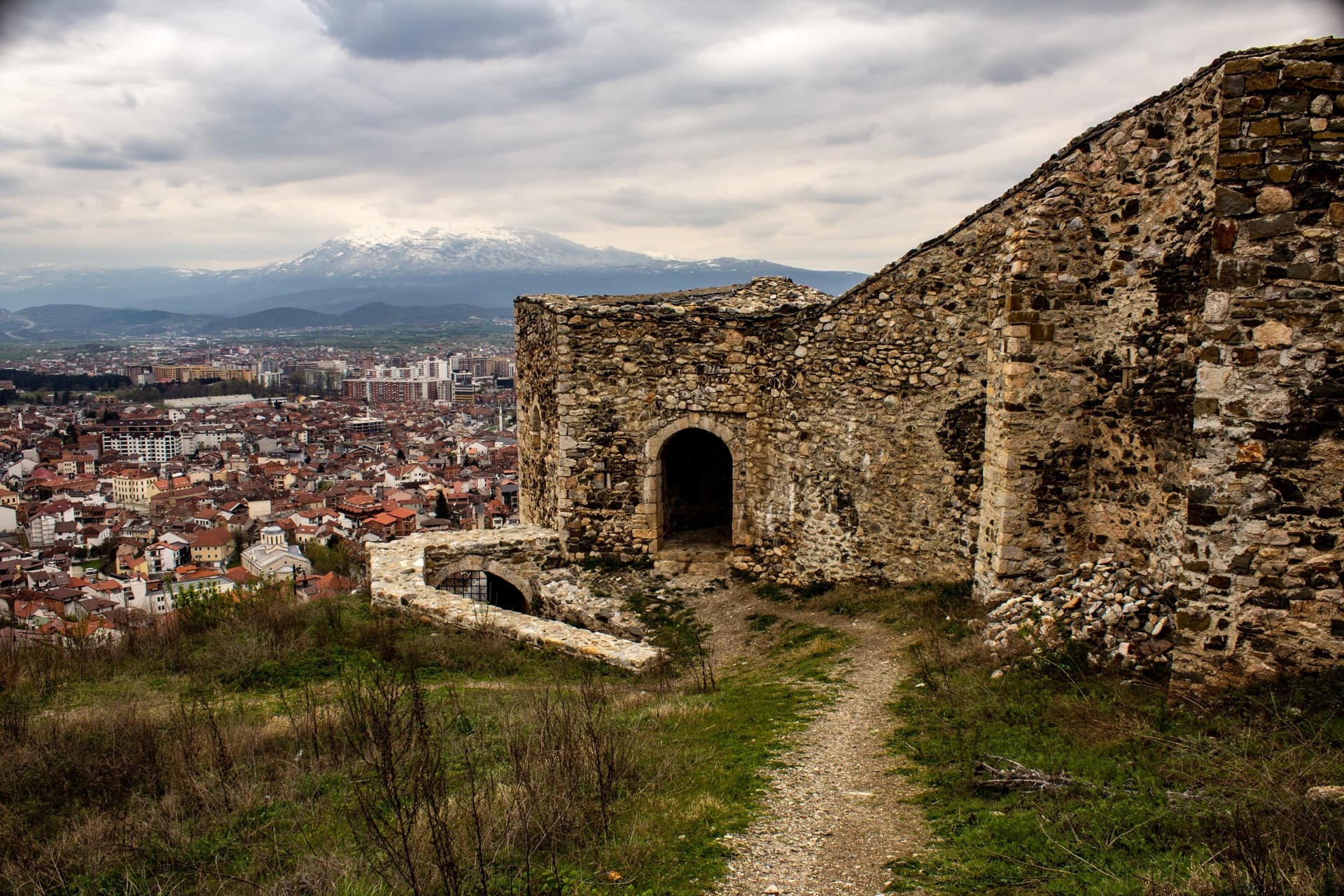
Towering above the city of Prizren, in southwestern Kosovo, Prizren Fortress (Kalaja e Prizrenit in Albanian) dominates the Bistrica River valley from its hilltop. Although situated beyond Albania's current borders, it holds an essential place in Albanian cultural heritage, as Kosovo shares much of its history with Albania.
Why visit Prizren Fortress
The site layers nearly three millennia of human occupation: Illyrian remains, Byzantine foundations, medieval Serbian additions, and Ottoman constructions coexist across approximately 1.5 hectares. Recognized since 1948 as a monument of special cultural importance, the fortress commands sweeping views from its ramparts across the Ottoman city, the Bistrica Valley, and surrounding mountains. Access is free, and the climb from the city center is on foot.
History
Illyrian and ancient origins
Archaeological excavations have uncovered prehistoric, Roman, and late antique layers beneath the current walls. The earliest traces of human activity date to the Bronze Age and the Illyrian period (from approximately the 6th century BC to around 1100 BC, according to studied strata). The Illyrians, considered the ancestors of modern Albanians, built the first defensive structures at this strategic location, which controlled passage through the valley.
Byzantine and Serbian period
The primitive form of the present castle owes much to the reconstruction ordered by Byzantine Emperor Justinian I in the 6th century. In the Middle Ages, the fortress fell under the control of several Serbian rulers. During the reign of King Stefan Dušan (1331–1355), Prizren became a secondary capital of the Serbian Empire, and the citadel played a primary military and administrative role.
Ottoman conquest and long dominion
In 1455, the Ottomans conquered Prizren and its fortress, initiating a domination lasting nearly 500 years. They reinforced the walls, added bastions and watchtowers, and constructed a mosque and hammam within the enclosure, whose traces remain visible. Military installations remained in service until 1912.
The League of Prizren and the modern era
In the late 19th century, the city became a center of Albanian national awakening with the League of Prizren (1878), which aimed to unify lands inhabited by Albanans. Although the League was founded in another city building, the fortress remained a powerful symbol of this period. Recognized as a cultural monument in 1948, it has been subject to ongoing restoration efforts since 2008.
What to see on site
Walls, towers, and the cannon
The enclosure, built from local stone, hugs the hillside contours on three sides. Watchtowers, positioned at regular intervals, punctuate the line. On one of the round turrets, an old cannon remains in place, aimed at the city below—a frequent photographic landmark of the site.
The inner enclosure
The main entrance on the western side opens onto a courtyard that once housed administrative and military buildings. Foundations, wall sections, and the remains of the Ottoman mosque and hammam survive. Basements and dungeons have also been uncovered beneath certain sections, used for provisioning or as prisons during conflict.
The archaeological museum
At the center of the enclosure, a small archaeological museum displays artifacts unearthed during excavations: ceramics, coins, weapons fragments. Informational panels in English guide you through the site.
Practical information
- Admission: free, no ticketing.
- Duration: allow 1 to 2 hours on site depending on your interest in remains and the museum.
- Difficulty: the climb is short but steep in places; closed-toe shoes recommended.
- On site: little shade and no water points within the enclosure; bring water, especially in summer.
- Signage: informational panels in English.
When to visit
The site is accessible year-round. The best periods remain spring (April–June) and early autumn (September–October), when temperatures are mild and light is favorable. In summer, heat can be intense on the sun-exposed ramparts: prefer early morning or late afternoon, which also offers the best views of the city. Since 2010, the fortress entrance hosts an open-air cinema each summer as part of Dokufest, the international documentary film festival held in Prizren.
How to get there
The fortress is most easily reached on foot from central Prizren. Allow about 15 minutes of walking via a paved path that winds through narrow streets, then climbs through a verdant area. Signage indicates the direction to the main entrance. Vehicles cannot access the enclosure; visitors with mobility challenges will find the route difficult.
Nearby
The fortress is best visited as part of a stay in Prizren, whose Ottoman center, stone bridge, and Sinan Pacha Mosque merit a half-day. Travelers continuing toward Albania can explore the Germenj-Shelegur national park and Mount Gjerë, or head south toward Farma Sotira, a farm lodge renowned for its trout and mountain setting.
Frequently asked questions
Frequently asked questions
It is located in Kosovo, in the city of Prizren (southwestern part of the country). It frequently appears in Albanian cultural itineraries, as Kosovo shares much of its history and culture with Albania.
Access is free and there is no ticketing at the site entrance.
Allow approximately 15 minutes to climb from the city center, then 1 to 2 hours on site depending on your interest in the ramparts and small archaeological museum.
The enclosing walls, watchtowers, an old cannon on a round turret, remains of an Ottoman mosque and hammam, basements, and an archaeological museum at the center of the enclosure. English-language panels explain the main features.
Spring and early autumn offer the most pleasant conditions. In summer, visit early in the morning or late afternoon to avoid the heat on the sun-exposed ramparts.
Include Prizren in your journey
Prizren Fortress naturally integrates into a cultural itinerary connecting Albania and Kosovo, spanning Ottoman heritage, the League of Prizren, and Southern Balkan landscapes. To plan a trip combining these two countries, consult our travel suggestions for Albania.
Interested in this visit?
We can include it in your personalised itinerary.