The Bunk Art Museum
The Bunk Art Museum
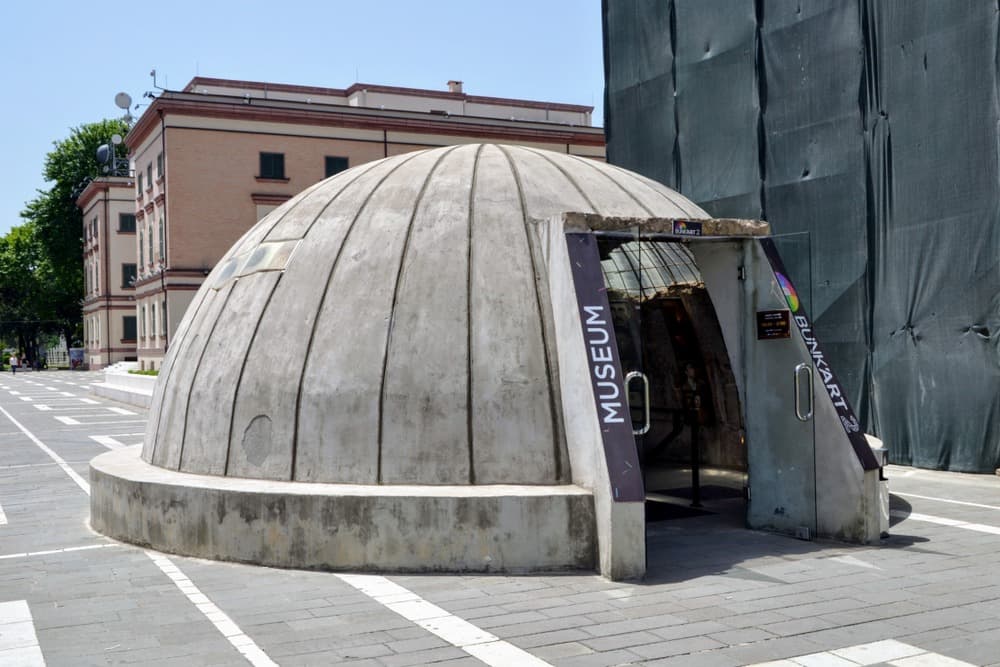
In Tirana, the two Bunk Art museums occupy former nuclear bunkers and chronicle four decades of communist rule under Enver Hoxha.
In Tirana, two former nuclear bunkers have been converted into museums under the name Bunk Art. Designed during the communist era to protect the political elite and secret police from a potential nuclear attack, these underground structures now host exhibitions devoted to Enver Hoxha's regime, political persecution, and twentieth-century Albanian memory.
Why visit Bunk Art
- Understand four decades of Albanian communism through original locations, preserved in their military architecture.
- Explore two complementary sites: Bunk Art 1, a sprawling peripheral bunker dedicated to the regime's general history; Bunk Art 2, located in the city center, focused on the secret police.
- View original documents, photographs, everyday objects, and contemporary installations within reinforced concrete walls.
- Easily combine a visit to Bunk Art 1 with a ride up Mount Dajti by cable car.
History of the bunkers and the museum project
Enver Hoxha, communist president of Albania from 1944 to 1985, led the country in increasing isolation. Haunted by fears of invasion or nuclear strike, his regime constructed countless concrete shelters across the territory—tens of thousands according to estimates. The communist system itself did not end until 1991, a few years after Hoxha's death.
The Tirana bunker, excavated in the 1970s, was exclusively reserved for the political elite and its existence remained secret for decades. It was never used: neither bombardment nor war struck communist Albania.
The museum project was led by Italian journalist Carlo Bollino, founder and general curator, with Admirina Peçi overseeing historical research. Bunk Art 1 opened to the public in November 2014. Bunk Art 2 followed on November 19, 2016, as part of Tirana's National Liberation Day.
What to see on-site
Bunk Art 1: the elite bunker
Located on the outskirts of Tirana near an active military camp, Bunk Art 1 is reached by a long tunnel carved into the hillside leading to the ticket office. The underground structure spans approximately 3,000 m² across five levels. The route passes through dozens of chambers equipped for high-ranking officials in case of invasion, as well as exhibition halls combining archival photographs, original documents, period objects, and contemporary art installations.
Among the striking contents: a retrospective of modern Albania spanning from the Italian invasion of 1939 to the collapse of communism, a video of Enver Hoxha's 1985 funeral, and several rooms evoking political repression. The former government meeting room has been converted into a jazz concert space, reflecting the site's dual role as both memorial and cultural venue.
Bunk Art 2: the memory of repression
Bunk Art 2 is located on Abdi Toptani Street, behind the Ministry of Internal Affairs, in the city center. More compact (approximately 1,000 m²), it is protected by reinforced concrete walls over 2 meters thick. Built between 1981 and 1986, it was designed to serve as a shelter for the secret police and Interior Ministry officials in case of atomic war.
The exhibition focuses on the history of the communist secret police and the persecution of over 100,000 Albanians between 1945 and 1991. Photographs, archives, and reconstructions document arrests, camps, and mass surveillance. Some rooms, by their subject matter, may not be suitable for young children.
Practical information
- Visit duration: allow 1.5 to 2 hours for Bunk Art 1, approximately 1 hour for Bunk Art 2. Both sites can be visited in the same day.
- Hours: daytime opening, closing in late afternoon. Check updated hours before visiting, especially outside peak season.
- Admission: moderate entrance fee, separate ticket for each site.
- Accessibility: numerous staircases, cool temperatures inside—bring a jacket even in summer.
- Audience: content can be challenging (repression, executions), to be appreciated according to visitor sensitivity.
How to get there
Bunk Art 1 is located on the northeastern outskirts of Tirana. From Skanderbeg Square, next to the Palace of Culture, a bus heading toward Linza serves the site. The route also provides access to the base station of the Dajti cable car.
Bunk Art 2 is in the city center on Abdi Toptani Street, a few minutes' walk from Skanderbeg Square. No specific transport is needed from the center.
Nearby attractions
- Dajti Express Cable Car: a short distance from Bunk Art 1, it ascends Mount Dajti and offers sweeping views over Tirana.
- Tirana center: Skanderbeg Square, Et'hem Bey Mosque, Clock Tower—to combine with a visit to Bunk Art 2.
- To extend your journey through Albania, Berat Castle, the ancient site of Butrint, or the Benja thermal springs are among the complementary stops.
Frequently asked questions
Bunk Art 1, located on the outskirts, occupies approximately 3,000 m² and covers the general history of the Albanian communist regime with an artistic dimension (concerts, contemporary art). Bunk Art 2, in the city center, is smaller (approximately 1,000 m²) and focuses on the secret police and persecution of opponents between 1945 and 1991.
The two museums are complementary. If you only have a few hours, Bunk Art 2 is more accessible from the center. For a more complete immersion in military architecture and the regime's history, Bunk Art 1 remains the most striking visit.
Some rooms address repression, executions, or detention conditions. The content can be difficult for young children, and the underground atmosphere may be unsettling. This should be evaluated based on individual sensitivity.
Allow 1.5 to 2 hours for Bunk Art 1 and approximately 1 hour for Bunk Art 2. Both can be combined in the same day, ideally with an ascent to Mount Dajti from Bunk Art 1.
Tens of thousands of concrete shelters were erected across the country under Enver Hoxha, from beaches to isolated valleys. They remain a visible element of the Albanian landscape and a material landmark of the regime's paranoia.
Include Bunk Art in an Albania trip
A stop in Tirana, and particularly at Bunk Art, provides valuable historical context before exploring the rest of the country. To build an itinerary combining the capital, ancient sites, Ottoman towns, and the coast, explore our Albania journeys.
Interested in this visit?
We can include it in your personalised itinerary.