The Museum on Water
The Museum on Water
Recreation of a prehistoric stilt village above Lake Ohrid (UNESCO), featuring a museum, Roman fortress and diving site.
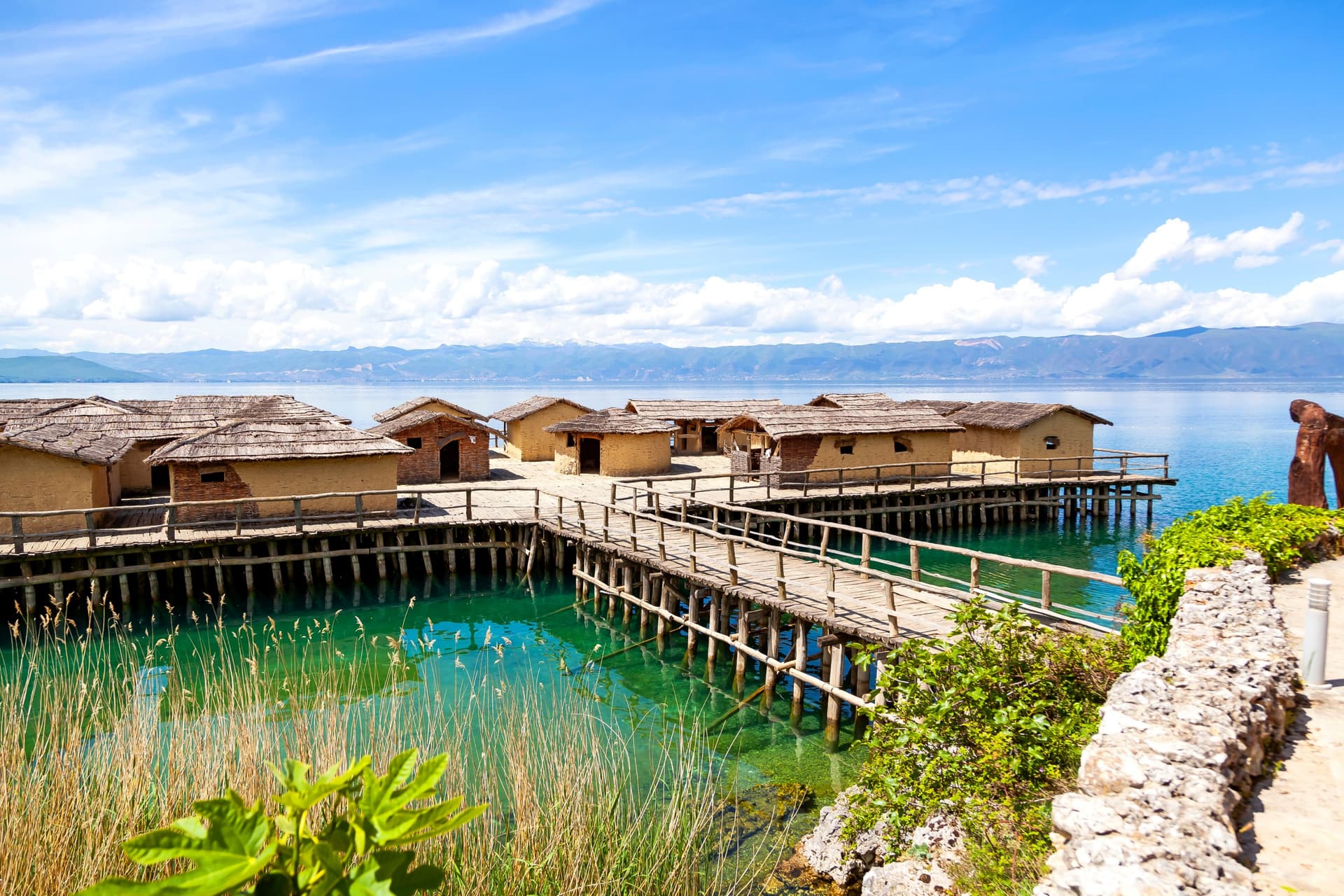
The Bay of Bones Museum, nicknamed the "museum on water," recreates a prehistoric stilt village above Lake Ohrid. The site sits on the Macedonian shore of the lake, roughly fifteen kilometers from the city of Ohrid, and stands as one of the most comprehensive archaeological reconstructions in the Balkans region. Though geographically located in North Macedonia, it fits naturally into cross-border itineraries offered from neighboring Albanie, with Lake Ohrid being shared between the two countries.
Why visit the museum on water
Three elements justify the detour. First, the staging itself: 24 round and rectangular houses reconstructed on a wooden platform set above the water, connected to the shore by a rebuilt bridge. Second, archaeological significance: the remains come from a settlement occupied between 1200 and 600 BC, whose original foundations rested on nearly 10,000 wooden stakes anchored into the lake bed. Finally, the setting: Lake Ohrid is inscribed on the UNESCO World Heritage list and ranks among the planet's oldest aquatic formations.
History of the site
During the Late Bronze Age and early Iron Age, populations built a lacustrine village in a sheltered bay of Lake Ohrid. Their dwellings rested on a wooden platform supported by approximately 10,000 stakes driven into the lake bed, a structure that originally extended across roughly 8,500 m² and housed about sixty houses. A movable bridge connected the entire settlement to dry land and could be raised in case of threat.
Archaeological excavations conducted between 1997 and 2005 brought up a substantial quantity of material: pottery, tools, animal bones. The museum opened in 2008, accompanied by the gradual reconstruction of the village on its original platform.
Origin of the name "Bay of Bones"
The designation "Bay of Bones" refers to the numerous animal remains and boat fragments discovered in the lake's sediments. No human bones were uncovered during the excavations: at that time, the dead were cremated, which explains the absence of burial sites on location.
What you'll see on site
The reconstructed village
The current platform features 24 replicas of dwellings, compared to around sixty in prehistoric times. Inside, stone and bone tools, utensils, ceramic vessels and pieces of weaving have been arranged to evoke the daily life of the inhabitants. The access bridge has been reconstructed, but without the original movable mechanism.
The museum building
Back on the shore, the main building displays original artifacts dated from the 12th to 7th century BC. A presentation by a curator allows the site to be placed within its regional context. A screening is dedicated to Lake Ohrid and the discoveries it has yielded.
The Roman fortress of Ploca Micov Kamen
On the hillside overlooking the bay, the remains of a small 3rd-century Roman fortress form part of the same archaeological perimeter (Ploca Micov Kamen site). The access path is short and offers a clear view of the platform, the lake and surrounding landscape. The spot is well-suited for a picnic break.
Diving on the submerged foundations
The waters of Lake Ohrid remain transparent down to about twenty meters, making it interesting diving terrain. The museum sector descends to 21 m, but the area open to divers is capped at 12 m for safety reasons. You can observe the original stakes still in place and, further into the lake, the wreck of a German boat sunk during World War II.
Practical information
- Opening: Tuesday to Sunday, generally daytime hours. Check seasonal hours before departure.
- Admission: modest entry fee (a few euros), providing access to the museum and stilt village.
- Duration: plan 1 to 2 hours on site, longer with the fortress or a diving session.
- On-site: a curator provides explanations; bring footwear suitable for the wooden bridge.
When to go
May through October is the most favorable period: the museum operates at full capacity, boat connections are regular and water is warm enough for diving. July and August draw the bulk of tourist traffic to the lake; for a quieter visit, favor late May–June or September. Outside peak season, boat rotations are spaced out and diving is often suspended.
How to get there
Two options exist. By water, water taxis and cruise boats depart from Ohrid; the most common circuit combines the museum on water with the Sveti Naum monastery, further south. This is the preferred option for most visitors. By road, the site is about 16 km from Ohrid following the P1301/P501; the route is straightforward. Taxis charge rates comparable to boats and a few local buses serve the area, though frequency is limited.
For travelers based on the Albanie side, access is via Pogradec then through the border crossing, which allows combining both shores of the lake in a single itinerary.
Nearby
- Sveti Naum monastery: located at the southern tip of the lake, near the Albanie border, a near-systematic stop on boat circuits.
- City of Ohrid: UNESCO-listed old town, the logical starting point for the visit.
- Pogradec: lakeside resort on the Albanie side, useful for reaching the other shore.
Frequently asked questions
Frequently asked questions
Continue your journey
Lake Ohrid is one of the major points of interest in itineraries combining Albanie and the Western Balkans. To integrate this visit into a broader trip, consult our voyages en Albanie and their cross-border extensions.
Interested in this visit?
We can include it in your personalised itinerary.